Supply Chain Triangle: The balancing act between costs and service level
How companies use mathematical optimization to make their supply chain more efficient
In today's business world, efficiency in the supply chain is a decisive competitive factor. Companies are under constant pressure to get their products to customers faster, more cheaply and more reliably. However, these requirements are often at odds with each other. If you cut costs, you risk longer delivery times. Those who increase service levels often have to accept higher stock levels. This area of conflict is known as the supply chain triangle - a classic conflict of objectives between costs, service level and cash flow (working capital).
This is where many companies face a key challenge: how can a balance be found between these objectives without one of them suffering permanently? In this article, we show how companies use mathematical optimization and the OPTANO solution for network optimization to successfully master the conflicting goals of cost and service level - and achieve impressive results in the process.
Complexity in the supply chain triangle: costs versus service level
The supply chain triangle is not just a theoretical framework, but a daily reality for those responsible for planning in companies. Every decision - whether on warehousing, transport logistics or the choice of location - influences at least two of the three target variables. For example, reducing stock levels reduces costs, but at the same time risks supply bottlenecks. On the other hand, those who increase the service level through high availability must expect higher storage and transportation costs.
These conflicting objectives are further exacerbated by external factors:
- Global supply chains with long transportation routes and geopolitical risks
- Volatile markets with fluctuating demand
- Rising customer expectations delivery speed and transparency
- Sustainability requirements, which entail new restrictions
Intelligent planning in the supply chain triangle: balancing trade-offs in a targeted manner
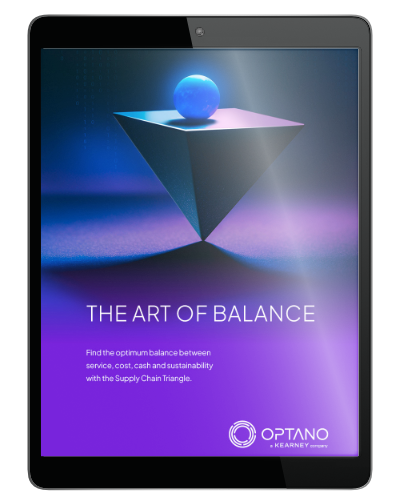
As already mentioned, the supply chain triangle illustrates very well that companies are always confronted with conflicting goals between costs, service levels and cash flow in their planning. It is therefore crucial to find the best tade-off, consciously manage it and thus create the best possible balance based on sound data.
Modern technologies such as mathematical optimization make it possible to make these complex relationships transparent and use them strategically. Companies can specifically analyze the impact of certain decisions on their supply chain - and thus take measures that are both economically viable and service-oriented.
Further interesting content
Mathematical optimization with OPTANO
OPTANO offers companies a powerful solution - based on mathematical optimization - to optimize the supply chain in a targeted manner. In contrast to traditional methods, the OPTANO solution for network optimization takes all relevant influencing factors and target values into account simultaneously. The software analyzes millions of possible scenarios and calculates the optimal solution, taking into account capacities, costs, delivery times, sustainability targets and much more.
In addition, the OPTANO solution for network optimization supports companies in making their supply chain strategy more robust and future-oriented in the long term. In addition to operational planning, the software also enables the evaluation of strategic options, for example when selecting new warehouse locations, introducing alternative transport routes or switching to more sustainable delivery models. By taking external influencing factors such as market changes, geopolitical risks or regulatory requirements into account, well-founded decisions can be made regarding long-term investments. This not only makes the supply chain more efficient, but also more resilient to future challenges.
This enables companies not only to improve their planning processes, but also to develop them strategically.
OPTANO in practice
Supply chain optimization in retail: Lower costs and satisfied customers
Based on successfully implemented projects, we would like to use a practical example to illustrate how our planning software helps companies to effectively overcome the challenges and complexities of supply chain management: A leading retail company was faced with the challenge of making its supply chain more efficient. The existing network structures had grown historically and were no longer optimally aligned with current market requirements. Long lead times, high stock levels and rising logistics costs were putting a strain on competitiveness. With the help of the OPTANO solution for network optimization, the entire supply chain was analyzed and restructured. Among other things, warehouse locations were reassessed, transport routes optimized and inventory strategies adapted.
The result:
- 50 % shorter throughput times
- 12 % lower logistics costs
- Significantly increased efficiency and cost-effectiveness
Optimal trade-offs and a good balance
Every day, companies have to make decisions that affect costs, service levels and cash flow - while taking complex dependencies and external influences into account. The Supply Chain Triangle makes it clear: there is no simple solution, but there are better ways to deal with conflicting objectives.
The OPTANO solution for network optimization provides companies with a powerful solution for mastering these challenges. The practical examples show: Mathematical optimization makes it possible to resolve apparent conflicts of objectives and improve the supply chain holistically. Those who invest in intelligent planning today will secure decisive competitive advantages tomorrow.
Would you like to know how your company can successfully master the Supply Chain Triangle? Get in touch with us - We will show you how OPTANO can make your supply chain more efficient, cost-effective and service-oriented. Or stay informed and download our detailed factsheet on this topic.