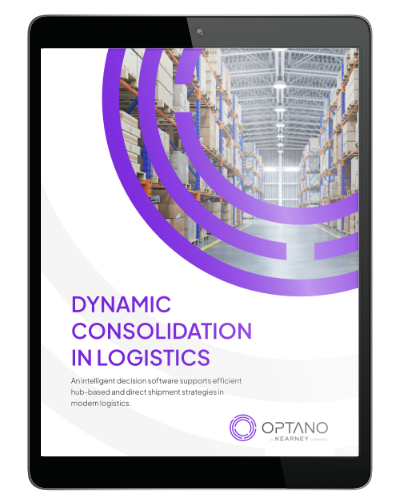
Retail logistics under pressure: when costs, delivery time and CO₂ count at the same time
How mathematical models make conflicting goals transparent and enable integrated decisions
Rising freight rates, volatile demand, increasing capacity pressure and regulatory requirements for CO₂ transparency are fundamentally changing logistics management. What was considered an operational discipline just a few years ago is now a strategic lever for margins, service quality and sustainability performance.
In practice, however, a recurring pattern emerges: cost-cutting measures worsen the service level, a higher delivery frequency increases emissions, and CO₂ reduction only seems achievable through additional costs. This is precisely where mathematical logistics optimization comes in. It makes it possible to solve these conflicting objectives systematically and simultaneously rather than looking at them in isolation.
The fascination lies less in the computing power than in the structured decision-making logic: complex networks become transparent, target effects become quantifiable and strategic options become comparable.
„As long as costs, service and CO₂ are managed separately, the results remain random.“
When every decision creates a conflict of objectives
Three goals, one system - and too many isolated decisions
Logistics managers operate in a field of tension. Procurement optimizes freight rates and tends towards bundling effects. Sales prioritizes delivery times and adherence to delivery dates. Sustainability demands a reduction in emissions and reliable Scope 3 data. Each of these perspectives is rational in itself - but together they create systemic conflicts of objectives.
For example, maximizing capacity utilization often leads to longer transit times or more complex route structures. Shortening delivery times requires additional direct transports or less consolidation. Switching to lower-emission transport modes influences cost structures and service levels. Without an integrated optimization approach, the result usually remains a sequential decision-making logic - and therefore suboptimal.
Operational transport planning is characterized by a large number of real constraints. Time windows on the customer and ramp side limit flexibility. Different transportation modes entail specific transit times, capacities and cost structures. Vehicle availability, driving and rest times and regional restrictions add to the complexity.
In addition, there are strategic requirements such as minimum service levels or defined CO₂ target values. In international networks, these effects are amplified by customs processes, hub structures or multimodal transshipment points. Complexity is not created by individual parameters, but by their interdependence.
Optimization in retail logistics
If you would like to find out more about optimization in retail logistics, visit our topic page.
When every decision creates a conflict of objectives
Why local improvements are no substitute for global optimization
Heuristic methods are rule-based and iterative. They improve solutions step by step without systematically searching through the entire solution space. This procedure is sufficient in stable, less complex structures. However, as soon as several target variables are to be optimized simultaneously, the probability increases that relevant combinations are not taken into account.
The limitation becomes particularly clear with multi-objective optimization - i.e. the simultaneous consideration of costs, delivery time and CO₂. Isolated optimization of individual targets inevitably leads to target shifts. What is missing is a mathematically sound approach that takes all restrictions and targets into account simultaneously.
„Heuristics improve local, mathematical
Optimization decides globally.“
Multi-objective optimization: from the search for compromises to structured decisions
Optimization begins where Excel and empirical values end
Mathematical optimization translates the real logistics network into a formalized model. Decision variables represent transportation relations, quantity flows or modal selection. Constraints represent time windows, capacities and service requirements. The objective function integrates costs, emissions and transit times into one structure.
In contrast to heuristic planning, the solution space is analyzed systematically. Modern mixed-integer models make it possible to identify global optima under realistic restrictions. This results in a reliable basis for decision-making that creates transparency regarding target effects.
A key advantage is the scenario capability. Changes in freight rates, emission factors or service specifications can be represented based on models. This makes strategic decisions quantifiable. Emissions are no longer reported retrospectively, but are actively integrated into decision-making processes. This changes the role of logistics optimization. It is being transformed from an operational planning tool into a strategic control platform that places procurement, sales and sustainability on a common data basis.
The decisive difference lay not in a single measure, but in the systematic consideration of the entire network.
Practical example:
Multimodal network under cost and CO₂ pressure
Initial situation
An international distribution network with several production sites and regional hubs was faced with rising transportation costs and ambitious emissions targets. At the same time, there were strict time window restrictions on the customer side as well as service level requirements with high adherence to deadlines.
Up to now, planning has been predominantly heuristic and relationship-based. Modal decisions were made historically and not systematically evaluated.
Model approach
The entire network was transferred to a mathematical optimization model. All relations, transport modes, capacities, transit times, emission factors and time window restrictions were mapped. Costs, CO₂ and delivery time were integrated as simultaneous target variables.
In addition, scenarios with changed freight rates and alternative modal shares were calculated in order to identify robust decisions.
Results
The integrated optimization made it possible to identify inefficient transport routes and make targeted modal shifts. Transport costs were reduced by eight to twelve percent. At the same time, transport-related emissions fell by fifteen to twenty percent. Average vehicle utilization increased by six to nine percent.
Strategic impact: Logistics optimization as a link between procurement and sustainability
Mathematical optimization creates transparency about target effects and makes target conflicts quantifiable. Freight tenders can be evaluated on the basis of optimized network structures. Modal decisions are made taking into account their impact on emissions. Strategic CO₂ targets can be anchored as hard constraints or as weighted targets.
Logistics optimization thus becomes an integrative instrument between cost responsibility and ESG strategy. Decisions are no longer made intuitively or historically, but based on data and supported by models. This creates a sustainable competitive advantage, particularly in complex networks with multimodal structures.
„Anyone who can quantify conflicting goals,
can also control them.“
Conclusion: Conflicting objectives are not a law of nature
The tension between costs, service and CO₂ described above does not necessarily arise from conflicting objectives, but from isolated decision-making processes. As soon as all relevant parameters are mapped in an integrated optimization model, transparency is created regarding real options for action.
Logistics optimization using mathematical methods makes it possible to cut costs by five to fifteen percent, reduce emissions by ten to twenty-five percent and significantly increase capacity utilization at the same time. The decisive factor is the simultaneous consideration of all target variables under realistic restrictions.
Complexity is not simplified, but mastered in a structured way. This is precisely the difference between incremental improvement and strategic optimization.
Systematically tapping potential
A thorough analysis of your own logistics network often reveals significant optimization potential. If you want to manage costs, service and sustainability in an integrated manner, you should systematically examine the possibilities of mathematical optimization.
OPTANO supports companies in modeling complex logistics structures transparently and creating a reliable basis for decision-making. The first step is a structured analysis of potential - as the starting point for a sustainable and economically convincing logistics strategy.
Further interesting content